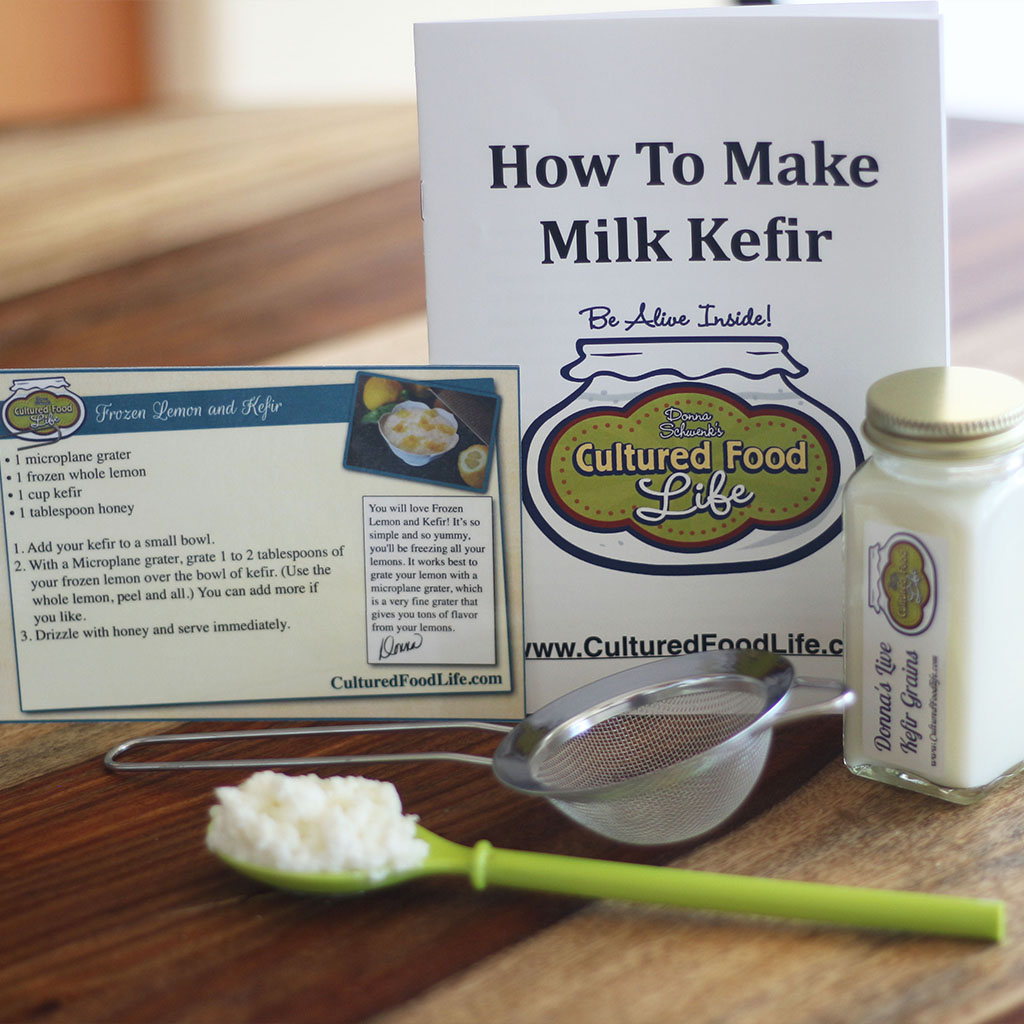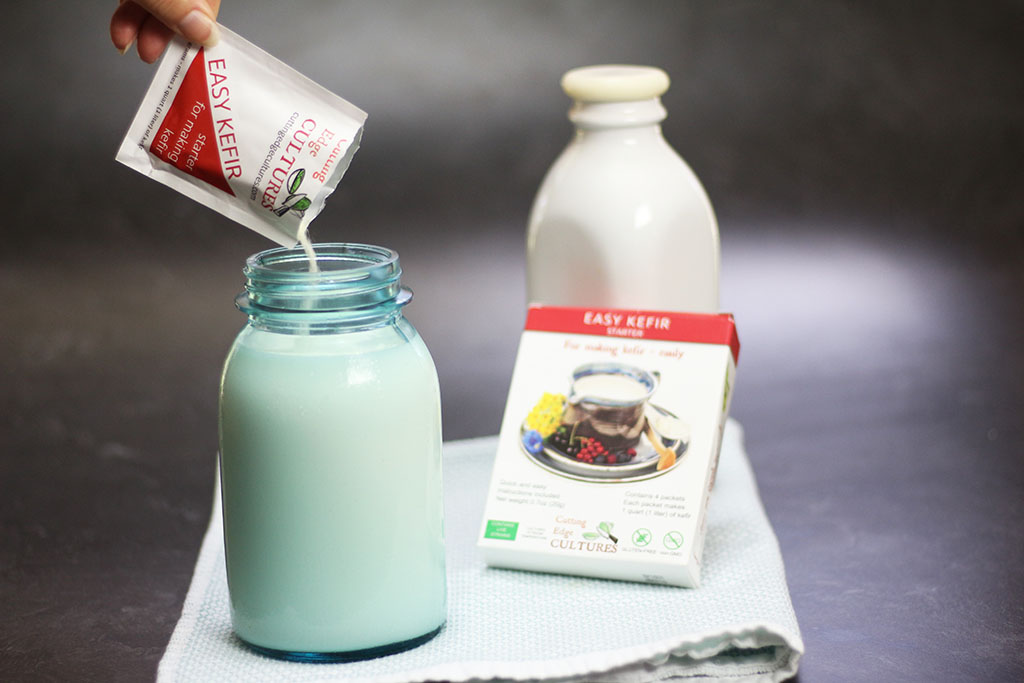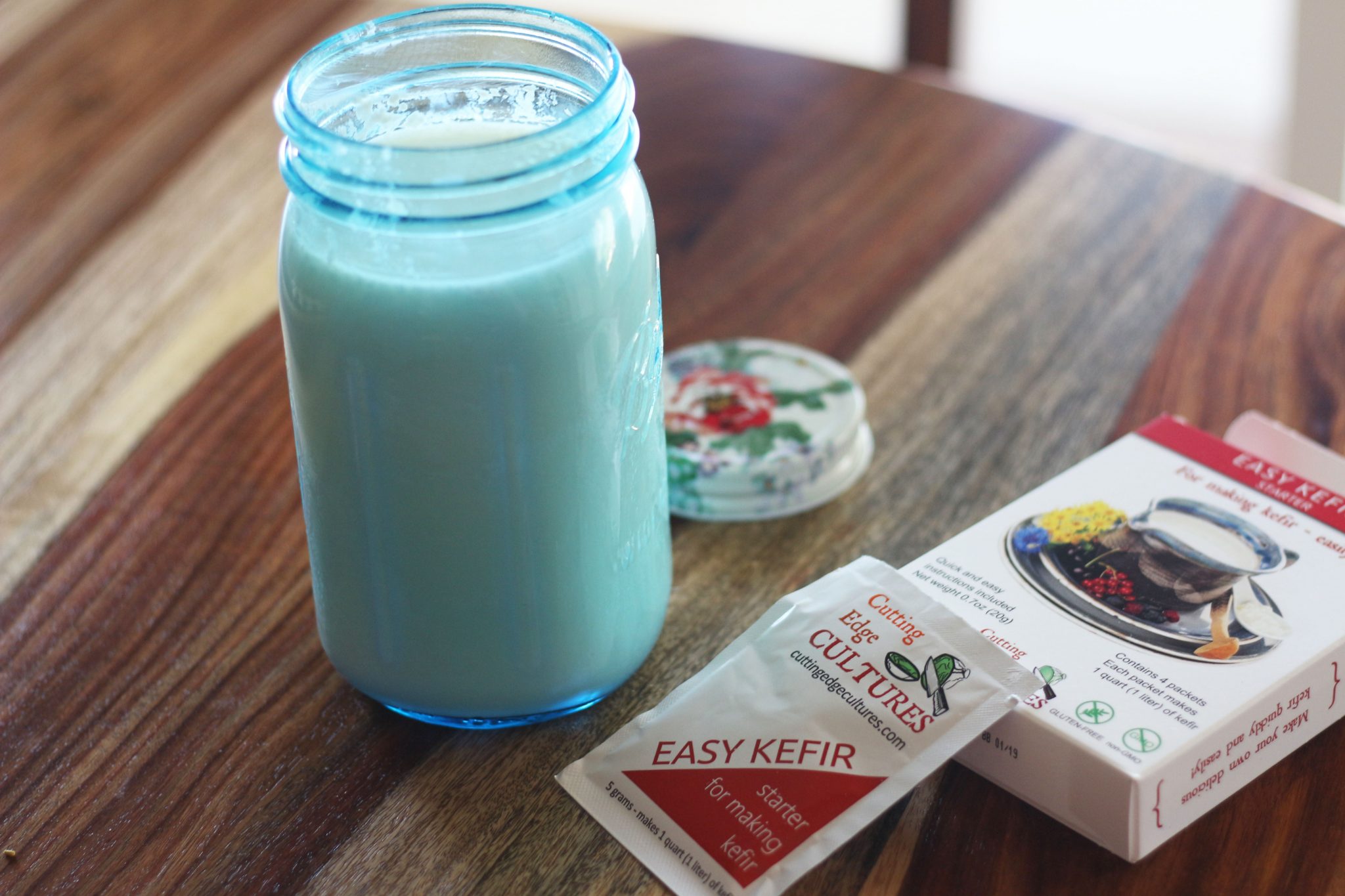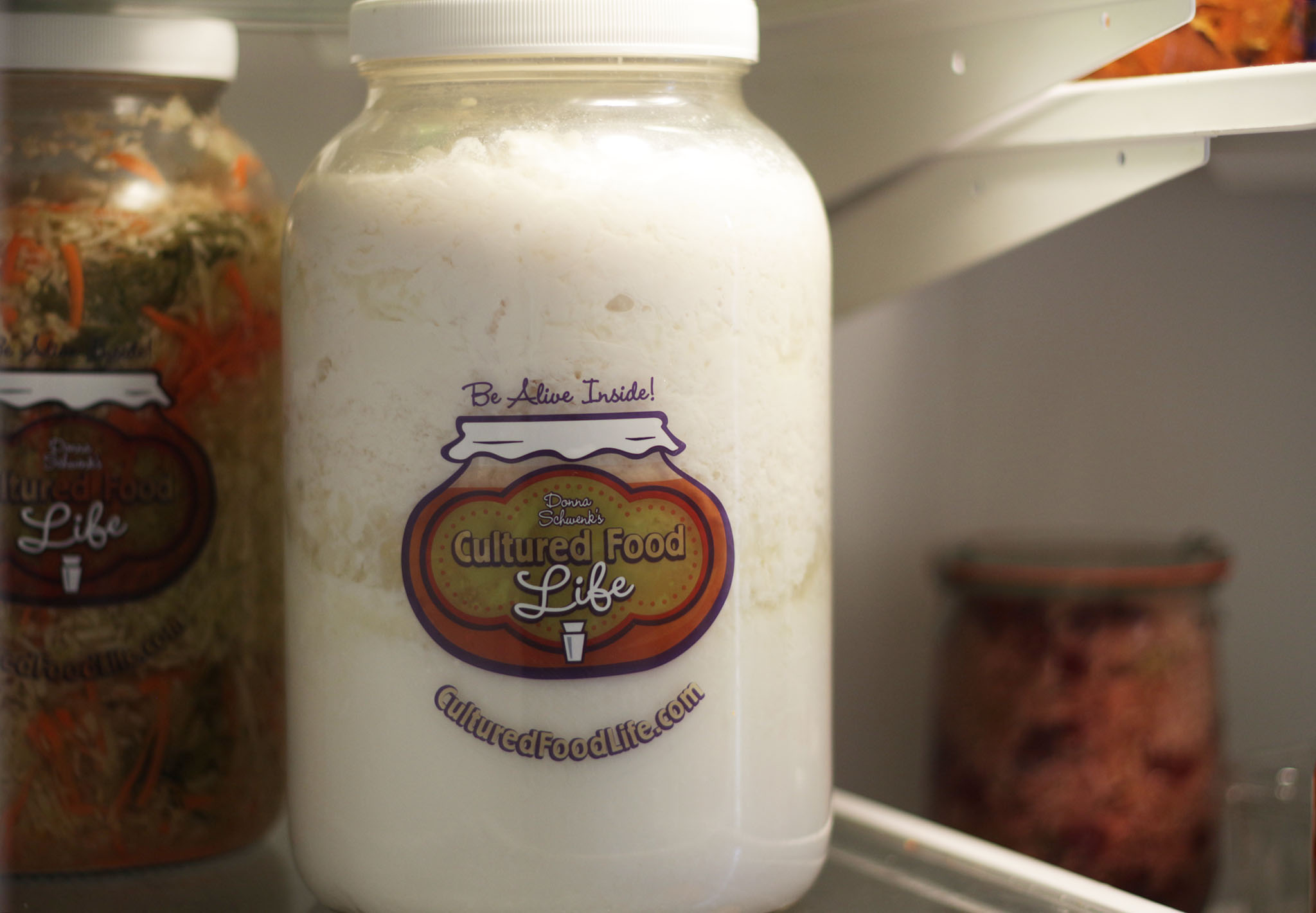

There are two ways to make kefir. One with grains that reproduce and will last a life time (if you don’t kill them with heat or starve them by not feeding them.) Or you can purchase kefir culture packages. You get 6 packages that makes 42 gallons of kefir. Instructions for this kind of kefir is inside the packages. This explanation is for kefir using kefir grains.
You have to find or purchase kefir grains. Here are some resources.
Heal Thyself has a community of people willing to share kefir grains.
For culturing 1 to 2 cups of kefir
1-2 tablespoons of Kefir grains.
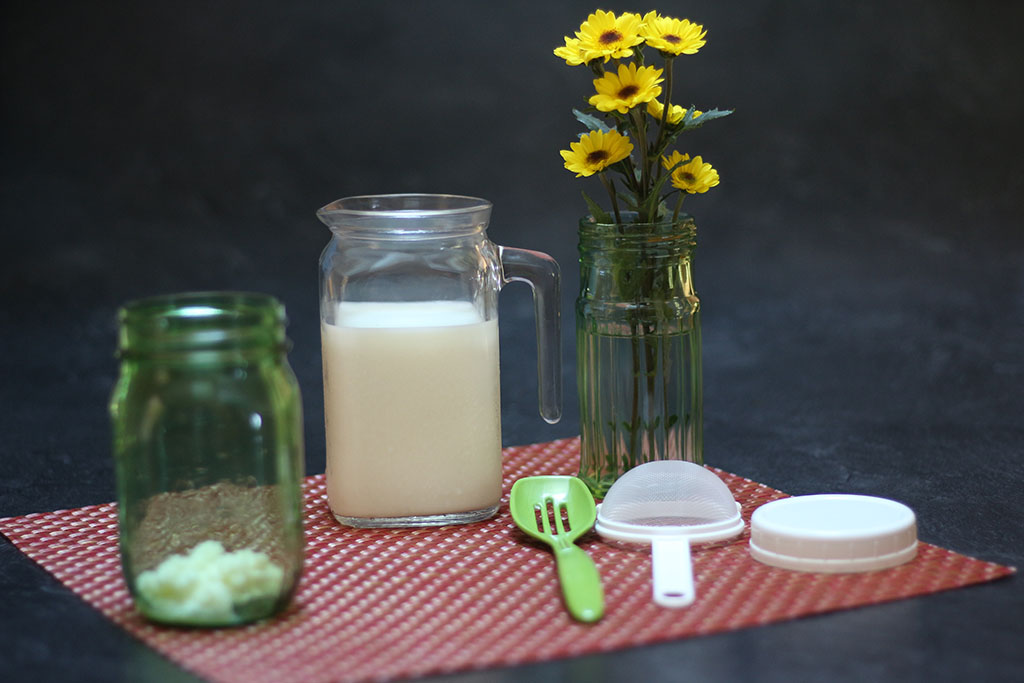
(3 to 4-cup) glass jar with lid or cover with plastic wrap I use a quart measuring jar.
Preferably a non-metal strainer and spoon
A non-metal container with wide mouth for straining and storing the kefir I like glass.
1 to 2 cups of fresh milk (Most milk-types are acceptable, including whole milk, fat-reduced, non-fat, pasteurized and homogenized. Although I mostly enjoy fresh raw whole cow’s milk to culture kefir)
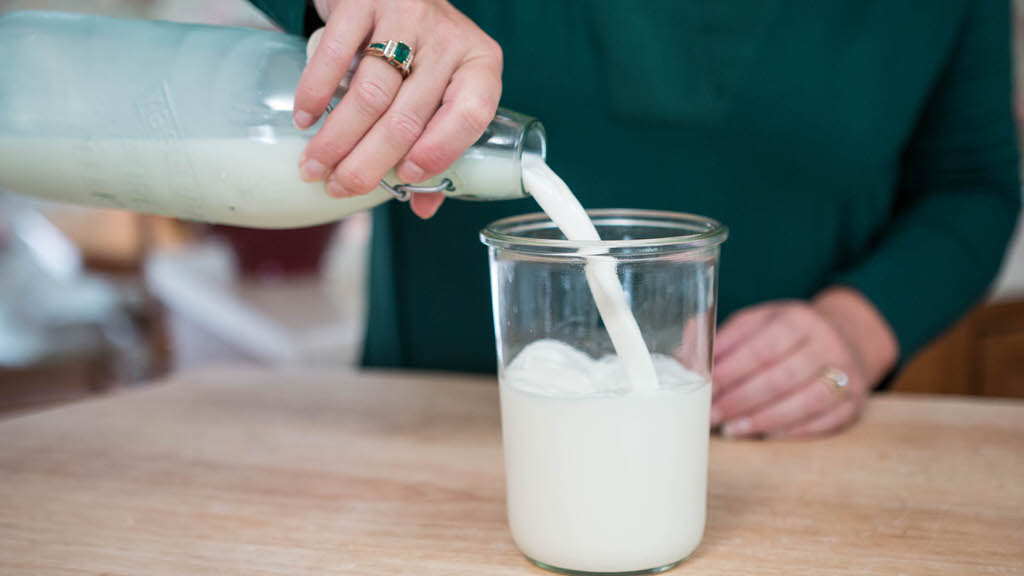
Place fresh kefir grains in a glass jar and fill the jar with fresh milk (best not to fill jar more than 2/3 – 3/4 full)
Place a lid on the jar or plastic wrap and let sit at room temperature for approx. 24 hours, or until the milk has thickened or has become sour to your liking (designate a spot for kefir fermentation in a cupboard or away from direct sunlight)
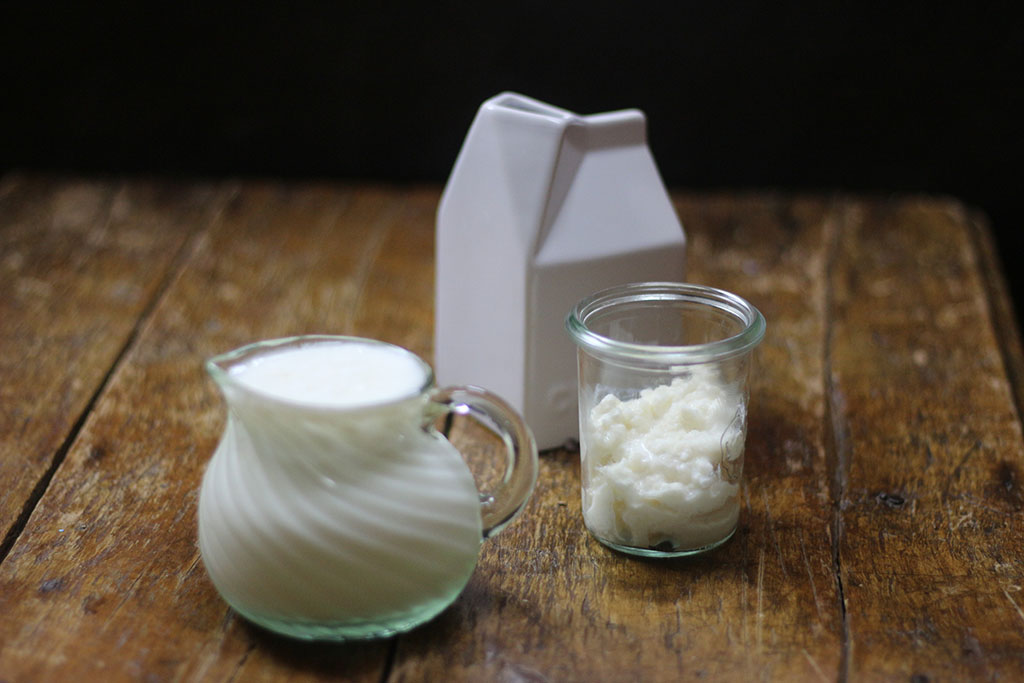
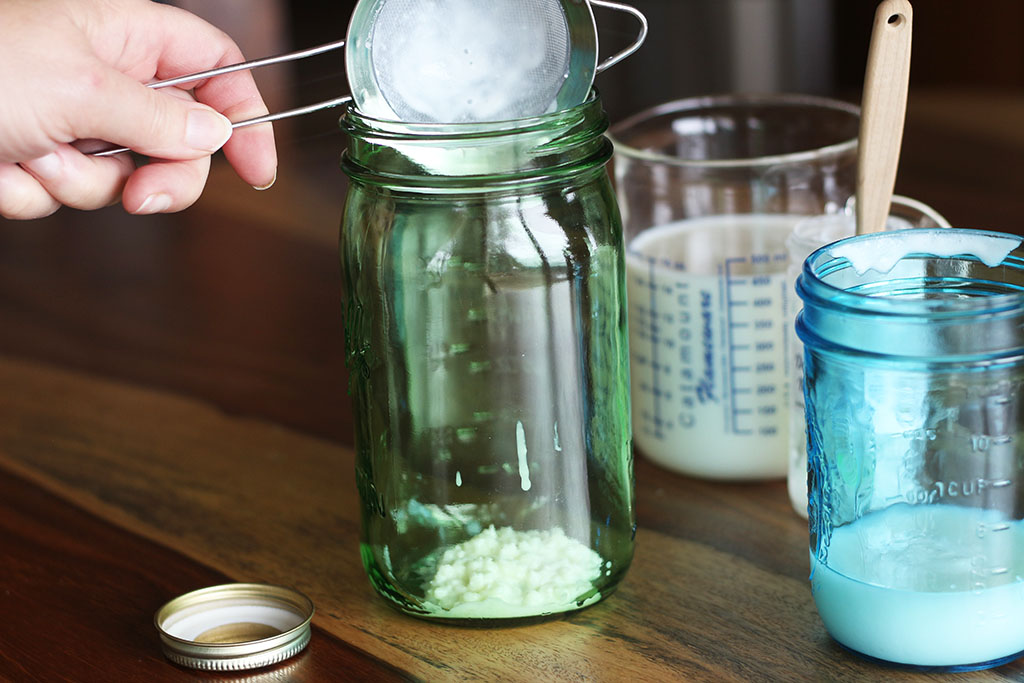
Pour the contents into a non-metal strainer or strain with slotted spoon.( I use a plastic slotted spoon) and strain the kefir into a container to separate the grains from the liquid kefir. What you’ve strained is kefir ready for consumption or you can put it into the fridge for later.
Wash the jar then place the kefir grains from the strainer back into the washed jar. [Do not add kefir grains to a jar which is hot from washing!] Then add fresh milk.
The whole process is simply repeated for the next batch.
Storing Your Kefir on Vacation.
If you don’t want to make new, kefir and want to store it, place it in at least 2 cups of milk remembering that if you have 1 Tbsp of grains to 1 cup of milk rule and adding a little more. I like to store mine in at least 3 cups of milk making sure that they have plenty of food to eat. Then you place this in the refrigerator. This will last for one week and then if you want to do it longer drain the milk and add new milk after 1 week. If you are going to be gone longer than a week double the milk you would add. It eats the lactose (milk sugar ) out of the milk and you want to be sure it has plenty to eat and won’t die. It is a living colony and needs food just as you do.
Second Fermenting Your Kefir

This is what I do on a regular basis. It taste better, less sour and the B vitamins sky-rocket. Once you try this you won’t go back to making it without 2nd fermenting. So Good!!
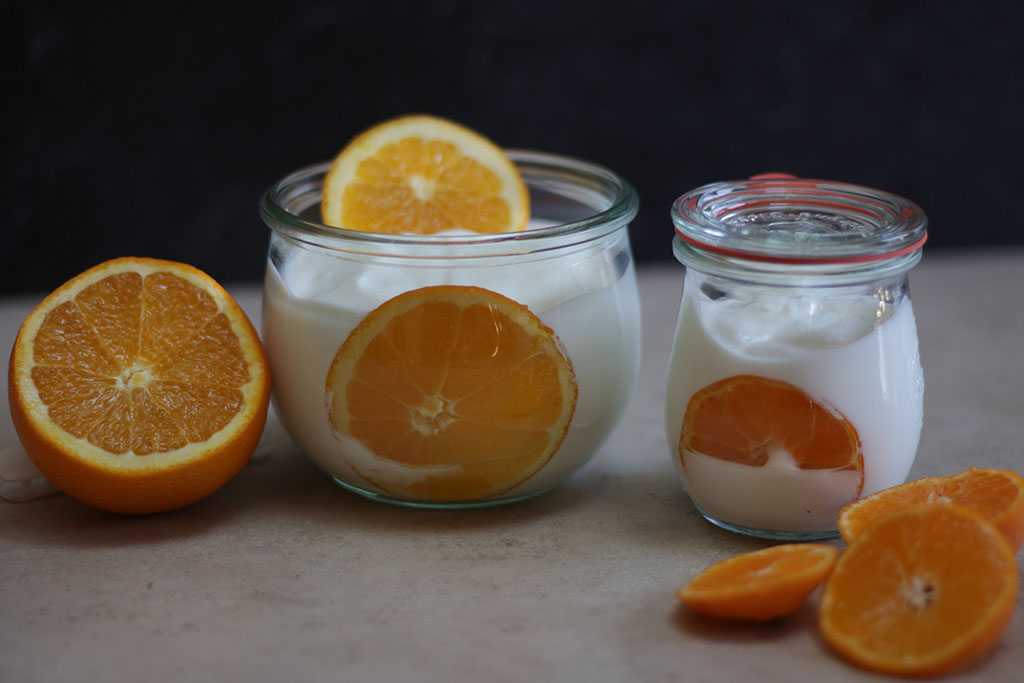
So here is what you do. It is super easy. After you make your kefir normally ( see above) and take the grains out, you place your kefir in a clamp down jar. Then you take an organic lemon or orange. If you don’t have an organic one you can make it chemical free by placing your orange or lemon in boiling water for 30 seconds, then rinse in cold water. Then you take a vegetable peeler and peel you fruit skin in strips and place it in your jar and clamp the lid down. Leave it on your counter for half a day to a whole day. Then place in refrigerator and enjoy. It is so yummy it is lighter and creamy and flavored with your lemon or orange. It has a little more carbonation and the taste is worth the extra half a day and it is better for you. A lot of people I know will leave their grains and ferment their kefir for days. Although this is not a bad thing it makes for super sour kefir. You hardly want to drink it, it is so sourer. Kefir is meant to be enjoyed and the better it taste the more you will drink it.
Things I have second fermented my kefir with are; lemon or orange peel, whole strawberries, chia tea bag, cinnamon stick, and vanilla extract. I take the item out after the second ferment and store the flavored kefir in the fridge.
Blueberry Banana Kefir Smoothie
1 cup of frozen blueberries
1 cup of kefir
2 pcks stevia or your choice of sweetener
Blend until smooth, then pour in a pitcher.
1 Banana
1 cup of ice
1 cup kefir
1 tsp vanilla extract
2 pcks stevia or your choice of sweetener
Blend until smooth, then pour in a pitcher.Then take a tall glass and pour at the same time from both pitchers into the glass.This will create the two-sided drink. Kids love this!


I just recently obtained kefir grains from a friend. I am noticing that after I strain the kefir it looks curdled and is watery but chunky. And my grains seem to ferment quickly and are very sour!!! Any ideas why it is so watery and curdled?! Thank you so much!
You will need to add more milk or take out some kefir grains they are fermenting faster because your grains have increased.
Donna, I’ve recently purchased kefir grains from cultures of health and am in the process of rehydrating them in raw, cow’s milk. the directions say 4-7 days for the rehydration process (my kitchen is ranging 70-80 degrees right now), but i’m curious as to how i know for sure that i have kefir. i am also having the cream separate from the milk as it sits on the counter and i’m shaking the jar every once in awhile. Is this Okay? i also just read you use a slotted spoon – the plastic strainer i purchased with my grains does not strain very well – i will be trying the spoon today. thanks!
It will thicken and sour the milk. When it separates is it thicker? Cream naturally separates so it should be getting thicker and tart. I stain mine with a strainer. Works really good to get the grains out.
The top gets nice and thick, while the bottom looks like whey (like when making cheese). The strained liquid is sour, but the issue I am having right now, is that when I go to strain the little guys, it looks like I have cottage cheese in my strainer (making it hard to find just the grains). I don’t know if my strainer holes are not large enough, but after watching videos on kefir, I should be getting a yogurt-y consistency, right? And then my grains should be easy to find. I went into the strainer with my fingers this last time and I can feel that the grains are not yet completely rehydrated – Am I still okay to use the kefir?
Yes you can still use the kefir. If it is separating into whey and cheese it is done. Give it few more days to rehydrate and keep making the kefir. They will get bigger and rubbery and you will be able to distinguish them easier. Then you will have so many you don’t know what to do with them all.
kate,
I had the same problem – I couldn’t even tell what was cream and what was grains…
I finally gave up and threw it all away. I was tired of wasting my precious raw milk!
I am thinking of trying water kefir instead…
So sad that you threw it away but understand if it felt frustrating to you. Please let me know if you ever want to try it again. I would be glad to help you have success with it. There are a lot more benefits with milk kefir than with water kefir.
Holly, I think I just wasn’t being patient enough. Surprisingly, making Kombucha is way easier (for me) than rehydrating kefir grains – it would have been a lot easier to find someone local with grains already producing. I finally ended up leaving the jar in the cupboard for two days and using a plastic colander – made the straining process easier. Don’t give up
But I would recommend trying to find someone with already hydrated grains. My little guys are definitely producing, and sometimes it is hard to tell, and man, two days in the cupboard makes for sour kefir, haha.
Such a great blog and very precis information. Thanks you for sharing your wisdom. I have been making kefir for about 6 months now and it was going great in the beginning but now my grains are acting strange. For almost a quart of milk I use only a tbs of grains and after 24 hours of fermentation they separate into kefir cheese and whey and kefir is never creamy. The taste is very mild and almost not sour at all (although I am used to drinking kefir and maybe am accustomed to the taste) . I think it is impossible to use less grains than this. Are my grains over active or am I doing something wrong? It looks like the ration of grains to milk is of.
Also my grains almost don’t grow in raw milk. I put them in home pasteurized milk once and they almost doubled in one fermentation. I really want to keep on making raw kefir, but it is just doesn’t seam to work right.
That is really interesting that your grains don’t grow in raw milk. Bacteria doesn’t like to be crowded so they are probably competing with the bacteria in the milk. There is room for them to grow in pasteurized milk because there is no bacteria. This is so interesting to me because this hasn’t happened to me. You may need to get some new grains or try a different source of raw milk. Maybe your raw milk has a strong strain of bacteria that is more dominant. Mmm I will have to think about this some more and get back to you. Bacteria is an interesting thing>
Thanks you so much for a quick response! The interesting thing is that the grains were growing in the beginning for about 2-3 months in the same milk I am using right now (the same source), than I ruined my grains (accidentally washed the jar with hot water with the grains in) and I got a new batch of grains from the same person that gave them to me the first time. He was using those grains with raw goats milk from the same farm and didn’t have any issues.
I was also wondering whether the location (surrounding environment) can have something to do with the problem, although I do close the lid during fermentation.
I really think you need to get some new grains. They are not acting right and I would hate for you to struggle with them if new grains would solve the problem.
I have had good luck using fresh raw goat milk for kefir though when I have to use store bought organic past. homogen. milk, the grains aren’t as happy & the kefir does not thicken as well.
Judi, my grains actually were very happy in a store bought organic past hom milk. So weird, maybe it is really the raw cow’s milk from this particular farm.
This morning, to my surprise, kefir turned out very nice (curds haven’t separated yet and it was creamy, but on a liquid side and very sour).
I think I’ll keep experimenting with the ratios.
Donna, if the texture is off, but the taste is fine (might be a little bitter), it is still ok to drink it, isn’t it?
If it sour is it fine. If it stays sweet it means the cultures aren’t strong enough.
I just ordered Milk Kefir from cultures for health and this is the third day I’m re-hydrating the grains. To my dismay, I noticed the milk I’ve been using is ultra pasteurized. I’ll be able to switch the ultra pasteurized with raw milk tomorrow, but is it too late? Will the kefir grains be salvageable?
You can cans go back and forth between any kind of milk and they will be fine.
Hi donna,
sometimes during the fermentation and/or second fermentation the curd and the whey reverse their places and the whey is on the top. Is that good or bad or does not matter? and why is that?
also, sometimes the kefir is creamy; sometimes it is more watery. please, explain.
thank you!
Sometimes it ferments a little more and this is why this happens. It is not a problem just means you can ferment it a little less time on the counter. Still perfectly fine.
Hello! Thank you for your great blog! I already rinsed my grains in filtered water, does that mean they are ruined? I put them in fresh raw milk and are waiting to see how they will turn out. Or should I just throw it all away?
They should be fine. If they thicken and sour your milk they are fine.
After a second ferment with fresh berries, or lemon peels, should I be straining off the peelings or fruit before I store it in the frig? Sometimes I think the kefir becomes less thick/more runny after being in the frig with the fruit and it becomes more tart.
You can do either, I have done both. I like leaving the fruit or peel in.
It is genuinely a cool and beneficial piece of information. I’m glad which you basically shared this beneficial data with us. Please stay us informed like this. Thank you for sharing. 744075
I just received your book. THank you for creating such a wonderful book with stories & info & recipes, all inspiring! My question to you is: On page 6 you explain second ferment with kefir. Is using a clamp down jar better then using a canning jar with seal & lid or even the white plastic lid? And I also have an air-lock gadget that looks like the type you have photographed on the back of your book. Would that air-lock gadget work as well? THank you. Judi
Yes they will all work. I like the clamp down jars and the air lock but they are not necessary you can also use a canning jar. They just work a little better.
Hi – I have some grains that I bought from Cultures for Health and am trying to make kefir with raw milk. My problem is separating the grains from the kefir when it is done. It gets thick and the cream goes to the top, which would be nice if I could get the grains out, but it is next to impossible to separate the grains from the cream at the top. I have a mesh strainer, but it is too thick to go through. I tried wrapping the grains in cheesecloth and putting that in the jar, but that makes a big mess, too – the cloth is all covered with thick cream.
Holly, do you have some whey that separates and goes through the strainer? Scoop the whey out of the bottom of the dish and pour it over top of the grains and it will loosen the thick curd up. Use a rubber spatula and stir it to loosen it up. That should help it to thin out so you can find the grains.
My sister in law suggested your website and my very first batch of kefir is on my counter almost ready to be consumed! i was recently diagnosed with type 2 diabetes and am excited to see what kefir can do for me! i am including my whole family in this kefir revolution! thank you sister sue for recommending this website and thank you donna for what you do! reading about it here made me brave enough to try it myself! good job!
Thanks Donna for your reply! One more quick question. On kombucha and water kefir you cover jar with coffee filter or something that lets the contents breath. Cutures for Heath mentioned keeping the milk kefir and water kefir 4 feet apart while fementing so they don’t cross culture. I notice you use a solid cover for the milk kefir? That would elliminate the need for distance if the milk kefir is closed, is that correct? Thanks again and love your site!
Yes, it does eliminate any cross culturing. Works great too.
Hi Donna, I attended your class a couple weeks ago at Green Acres and bought some milk kefir grains from you. I have made water kefir for 2 yrs and am used to the way these grains grow. Will the milk kefir grains always stay lumped together and just continue to grow connected together? Although I use a fine strainer, at times I wonder if I’m straining out small new growth. Also, I am currently using raw goat milk from my freezer (thawed first), is that OK? I see you mention coconut and almond milk, but does soy milk work as well? Thatnks!!
Yes, your grains will grow and multiply and you will get baby ones unless you strain them out accidentally.Some of them stay together but then other ones will split off of them. Very different from water kefir grains. You can use any type of milk but they do need to be refreshed in regular milk once a week. They need the lactose to keep producing their good bacteria’s.
If you don’t make more and just store it in the frig, do you boil the milk first (like a regular batch)? Do you pour off that milk to start another batch, or just set it on the counter, or will it ferment on it’s own in the frig?
I never boil the milk. The microbes in kefir dominate and control the environment, keeping harmful bacteria at bay. Very very safe and no need to boil milk. Are you using the culture packages or the kefir grains?
I just received grains from a friend. Left them in their raw milk bath on my desk at work. When I came in the next morning they had been accidentally refrigerated. Took them out immediately and let them return to room temp. When I got home (8 hours later) I fished them out, rinsed them in filtered water and returned them to a clean jar with raw milk that was starting to be a little past it’s prime (still drinkable, but with a stronger taste). Within about 4 hours everything had thickened nicely, no curds and whey, but smelled yeasty and had a slight bitter taste. Did I ruin my grains? I have since fished them out again, rinsed them and returned them to a clean jar with fresh raw milk to see what happens. The grains smell yeasty, but there’s no mold. What’s going on? Will my kefir forever taste weird or can I reset the taste by refreshing grains in fresh raw milk?
Thank you! I’m so inspired by your blog and I cannot wait to buy your book and hopefully sell it in my store!
Hi Tyra,
All you need to do is put them in fresh milk and culture them again. Don’t rinse them in water, it washes off the good bacteria and can damage them. It seems to be making kefir very fast for you, which means you need to add a larger amount of milk to the grains. The yeasty smell is probably from the raw milk that was a little past it’s prime. There are good bacterias in raw milk and combined with kefir can make it a tad more yeasty when the milk is not as fresh. Still good for you but not as tasty. It is usually just the cream or surface area at the top of the finished kefir that has the yeasty taste. You can always scrape it off if it is not to you liking. Your grains will be ok just give them fresh milk and add a little more than normal maybe a half a cup. Sounds like you are doing a good job and I love that you care so much about doing the right thing by your grains to make kefir. Will be a fun journey for you making kefir. I can tell from your post. Made me smile.
In your picture of 2nd fermentation above it looks like the kefir is separated? Can you explain the different colors in the jar? I found some raw goat milk and made 1 cup kefir today and am 2nd fermenting with lemon and have the grains going for their 2nd cup. The goat milk has a pretty strong “farm” taste to it and wondering if I will be able to 2nd ferment that taste /odor out. I got some hand-me-down kefir grains and I think they like the goat milk. Just doing 8 oz at a time to get the grains working and growing well again. Any suggestions on flavoring the “smell” out would be appreciated. Having grown up on a farm, I am unusually sensitive to the smells/odors/tastes of things unfortunately. Thanks for your help!
The kefir is separating in that picture. It just depends on how long it sits out. You can always just mix it up if it separates it isn’t a bad thing, just means it fermenting quickly. The reason that goat milk gets that smell is the enzymes in it that starts to break down the milk. The fresher the milk the less goaty taste. Not much you can do about the strong taste. Second fermenting does help but does not get rid of it.
Does Almond milk kefir or goat milk kefir produce the same good bacteria etc as regular milk? I would consider water kefir but it doesn’t have the same number of good probiotics etc. or so I’ve read. I cannot locate fresh goat milk or that would probably be my choice. Quite surprised at how it tastes and yet left no after taste.
Yes it does produce probiotics. There are more beneficial bacteria’s in milk kefir and goat kefir. It is the lactose in milk that bacteria loves and it actually makes it flourish. If you do make it with almond or coconut you need to replenish it once a week in a glass of milk kefir. Still you do get good bacteria’s but not as much.
Thanks for your help! I love your blog. I do have one question. My Kefir is not thick at all like your picture. There are curds floating on the top like cottage cheese but the milk is still runny. Am I putting too much milk in with my grains? I have about 2-3 T of grains and I use about 2 cups of milk. Also, will my grains grow or will the amount of grain I started with stay the same. One more question! Should I rinse my grains or just throw them back into a clean jar and start over? Thank you so much!
You are probably adding to much milk. Your house may be cold and fermenting slower. Add less milk and maybe let it sit longer than 24 hours or until thick. You grains will grow and multiply than you can add more milk. Never rinse your grains and damages them. Let me know if you have more questions.
OK, I let it ferment for two days this time and it still looks like cottage cheese on top with watery stuff (whey?) on the bottom of the jar. So my kefir is really watery. I am going to second ferment it and see what happens. Also, I’m making the new batch with less milk, I hope it works! Thanks so much for your help!
I would only let it ferment for one day. It has separated into curds and whey which means it has over fermented. This isn’t bad but will make it super sour. Just try it for 24 hours till it is thicker and hasn’t separated.
Hi Dona If my Kefir over ferments I just pour our a little of the liquid whey and then blend the remaninder after removing the grains, I add a banana or some other fruit and it makes a superb drink still.
Hi Donna,
I made Kefir for the first time from grains I received from a donor online, and tried several times.
Mine always separated into curds and whey( and very sour) within a few hours. I never seem to get the creamyness, yogurt like texture. Is it too many grains? Is the whey and curds reusable? I did take the curds and added some spices to make a cheese spread, althought very sour! I don’t know if I was supposed to use these or not! I have been buying kefir in the store, and mine turns out nothing like this!
You probably have to many grains to the amount of milk you are using. Double or triple the milk or take out some of the grains and see if this helps. The whey and curds are reusable. You can add all the spices you want. I do this all the time. Your kefir can also culture faster if your kitchen is warm. Try it again with less grains or more milk.
Donna,
You are a blessing. I have ordered your book from Amazon and am quite excited to study it and start implementing more of this into my life. I have been doing raw milk kefir for a month and my sugar levels have dropped.
My question is do these cultured foods help with reducing or eilimination of environmental allergies like cedar? I suffer tremendously due to cedar allergies (living in the allergy capital of the world – Austin, TX) and am trying to find anything that will help.
Any suggestions?
Many thanks and I hope a lot of folks benefit from your work
For the double fermentation how much fruit peel do I use?
For about 4 cups of kefir I use a few slices of lemon peel about a half a lemon.
The milk grains that I purchased say they have to be rehydrated for 5-7 days before I get kefir. Is this true?
If you got them from Cultures for Health this is correct.
All of the things mentioned that will help the body heal and keep it healthier are great. But I have been diagnosed with a dairy allergy as well as gluten because of Celiac disease (no wheat, barley, rye, oats). The sourdough bread sounds especially good. I don’t know that I can have the things that call for milk, for example (to make Kifer) and you can’t make sourdough bread without wheat flour. If I could have any of the forbidden foods that would be great. Is there something I don’t know that would say I can have those foods and not suffer?
You can make kefir with coconut milk or almond milk. You will need to replenish the kefir grains once a week in a cup of regular milk to give them the lactose they need to survive and grow. You can buy coconut kefir at many health food stores if you don’t want to make it. Many times after the gut will heal with kefir and cultured veggies you can add wheat back in the form of sprouted or sourdough. I have seen this many times. They gut gets damaged and needs to be repair with cultured foods and real fats and real foods. Here’s a link that might help. http://culturedfoodlife.com/gluten-pain-the-best-teacher-strawberry-gingerade-coconut-kefir/
What kind of almond milk works with kefir grains? I tried some freezed dried packets in almond milk this week and it didn’t do anything…although it said to heat the milk to 180 and i did not. I tried the same kefir packet with goat milk, did heat it, and it soured but did not thicken or anything…but…it was ultra-pasteurized. I keep Silk Almond milk on hand at all times and it does not have carageenan but didn’t think that would work with kefir grains? I cannot do milk due to protein allergy. Coconut milk in the store contains either preservatives or carageenan which i was told would not work by the kefir culture website on your blog here. Would really love to add Kefir to my life but cannot figure out how to do it….any suggestions?
You can add kefir grains to almond milk. It doesn’t get as thick as regular milk but still you will have kefir. You will need to replenish your kefir grains in a cup of regular milk once a week. They need the lactose to stay producing the cultures you need. Goats milk doesn’t get as thick either but if it was sour it was kefir. Try the almond milk and kefir grains and it should work for you.
I forgot to mention that I used to whey from that milk kefir batch to make that Christmas Kraut so I want to be sure it’s truly kefir whey and not just sour milk whey. I just wish I understood the ‘science’ behind culturing foods so I’d feel better about diving into this adventure!
To make kefir whey you can find it here. http://culturedfoodlife.com/easy-whey-kefir-cheese/ The bacteria in the kefir whey dominates and controls harmful bacteria and preserves the food making it impossible for harmful bacterias to thrive. It really is a wonderful way to preserve food and your body.
I’ve kept my milk kefir grain in milk in the frig because I can’t drink it enough to keep it going on the counter. It still ferments nicely, just takes longer, which is fine and my cats love it. I recently put it back on the counter again to give it another ‘go’ and it fermented in one day to curds and whey. But how can I be SURE the grains are still ALIVE and making kefir? How would I know I’m not making plain old milk gone sour on it’s own? It smells sour and I haven’t tasted it yet, but I would guess it tastes sour too. Seems to be a fine line between the sourness of milk kefir and plain old sour milk. Last thing I care to do is make myself sick! LOVE YOUR SITE!
You can tell if it is kefir because it will thicken and turn sour. Regular milk rots and does not turn sour.
Hi there. I’m new to kefir making so blogs like yours are really enlightening. However, i need help in making mine. My problem is my grains, which I got from a donor, do not look like the ones in the picture. They’re small, some even escaping through the strainer holes (and I mine is of fine mesh) and not clumped-together. When I was using cow’s milk from the box, I got the sour-y taste of yogurt and I could see and collect the tiny bits of kefir grains when strained. However, when I switched to raw buffalo milk, they curdled into something of a cottage cheese consistency after 24 hours that all I get is whey and the rest is cheese-like. How will I find my grains? Do I wash the milk away to find my grains? Because of this, I have not had kefir smoothies for 2 days already. Help! Thank you.
If they are small they should grow if you keep making kefir. They are not water kefir grains are they? These are more sandy in nature and won’t make milk kefir.
If they buffalo milk curdled it meant that the milk over fermented. This isn’t bad but your grains although little are very strong. You can add more milk and it won’t separate as badly. This isn’t a bad thing when it does separate, it just taste more sour. I would find the smallest mesh strainer I can find. Don’t rinse them with water it damages them. You can rinse them in fresh milk until the curds melt a way. Just place the strainer with the grains over a bowl and pour a 1/2 cup of milk on them and keep getting the milk that is strained through and pour it over them again and again until you find them.
[...] down and ask for more. I have really been digging making my own probiotic-filled foods, like kefir, lately. The kids are amazed that mommy makes it from scratch, adding major sparks of interest. [...]